
Harper County Arrest Records and Court Charges
Harper County arrest records are law-enforcement records tied to an arrest or booking event. They may involve the Harper County Sheriff's Office, a city police department, Kansas Highway Patrol, or another agency. The official research did not locate a Harper County online jail roster, booking report, mugshot list, or public active-charge lookup on county pages. For immediate custody or booking status, the official path is the sheriff's office phone channel, not an unofficial roster site.
Court charges after arrest are different. After an arrest or investigation, the prosecutor decides what charges to file. The Harper County Attorney is the local prosecutor for county criminal matters. Once a complaint, information, or other charging paper is filed in District Court, the filed charges become part of the court record. The full case file, including pleas, hearings, disposition, and sentencing, belongs with Harper County criminal court records.
Booking Records and Sheriff Contact
The Harper County Sheriff's Office page names Sheriff Tracy Chance and Undersheriff Kenny Hodson Jr. The Kansas Sheriffs' Association listing identifies Tracy Chance as Harper County Sheriff and gives the sheriff's office phone as 620-842-5135. Research found no official county jail roster, inmate search form, public booking report, warrant list, or online charge roster on the inspected county sheriff page. That absence should be stated plainly because many third-party sites imply more local booking access than official sources support.
Harper County Sheriff's Office
115 N. Steadman
Anthony, KS 67003
620-842-5135
Booking information can be time-sensitive. A person may be arrested but not yet formally charged, released before filing, held on a warrant from another court, or charged later after prosecutor review. Bond and first appearance information may appear in the District Court record after filing, but the sheriff is the best official source for current custody questions when no online roster exists.
Prosecutor Filing Decisions
The Harper County Attorney page names County Attorney Brandon Ritcha, support staff Amy Pollard-Meek and Jana Cashier, and lists the office on the fourth floor of the courthouse in Anthony. The office email is countyatty@harpercountyks.gov and the phone is 620-842-6070. The County Attorney reviews law-enforcement reports and decides what court charges after arrest should be filed, amended, dismissed, or handled through diversion when the case is eligible.
The Harper County Attorney source is a key official page for local prosecution and diversion contact details.
For Harper County arrest records, that prosecutor page helps connect the booking event to the later filed charge record in court.
Charges After Arrest Documents
Formal charges are filed in charging documents. The research identifies complaint and information as common criminal court record terms. An indictment is less common in ordinary county court explanations, but it remains a charging-document category in criminal procedure generally. In Harper County, the filed court document matters more than the name used in casual speech. A booking allegation, arrest reason, and filed charge may not match word for word because the prosecutor can decline, refine, add, or amend counts.
| Document | Who Files or Initiates It | What It Does |
|---|---|---|
| Complaint | Usually law enforcement or prosecutor, depending on case process | Starts or supports the criminal charge and states the accusation. |
| Information | Prosecutor | Formally states charges the prosecutor files in court. |
| Indictment | Grand jury process when used | Accuses a person of crimes after grand jury action. |
One arrest can lead to no filed case, one filed count, or several filed counts. A charge can be amended as the prosecutor reviews evidence or as plea negotiations progress. The court record should be checked by count, not only by case caption.
Find Harper County Arrest Records and Charges
There is no official Harper County online arrest roster in the inspected sources. The practical search path splits into two channels. For custody and booking, call the Sheriff's Office. For filed charges, search Kansas CaseSearch or contact Harper County District Court. If the matter is a city ordinance or municipal traffic case, contact Anthony, Harper, or Attica Municipal Court based on the citation or notice.
- For current custody or booking questions, call the Harper County Sheriff's Office at 620-842-5135.
- For filed court charges, search Kansas CaseSearch by defendant name, case number, or citation when applicable.
- Review each filed count, case type, hearing date, bond event, and disposition.
- Contact Harper County District Court at 620-842-3721 or allcourt@harpercountyks.gov if the record is missing, restricted, or not clear.
- Use municipal court contacts for Anthony, Harper, or Attica tickets and ordinance charges.
Note: A booking allegation can change before court filing, so the filed charge record is the better legal reference.
Harper County Charge Status Terms
Charge status is the current condition of a filed count. A pending charge is unresolved. An amended charge has been changed from an earlier version. A reduced charge is a lower or different count, often due to plea negotiations or evidence review. A dismissed charge was ended by the court or prosecution. A diversion status can mean the case is being handled under a diversion agreement rather than moving directly to conviction and sentence.
| Status | What It Means |
|---|---|
| Pending | The charge remains active and has not reached a final outcome. |
| Amended | The filed charge was changed, corrected, added to, or replaced by another count. |
| Reduced | The charge was lowered or changed to a less severe offense or different count. |
| Dismissed | The charge was ended and did not result in a conviction on that count. |
| Diversion | The defendant may complete agreed conditions under the prosecutor's diversion program. |
| Convicted | The charge ended in a guilty plea, verdict, or finding accepted by the court. |
Charges vs Convictions
Arrest records and court charges after arrest should not be read as proof of guilt. A filed charge is an accusation. A conviction is a court outcome after plea, verdict, or finding. Harper County charge records can show counts that were amended, dismissed, reduced, diverted, or resolved in a way that differs from the original arrest allegation.
- Charge
- An accusation filed in court after arrest or investigation. It may be amended, reduced, dropped, diverted, or dismissed, so the charging document and docket entries must be read with the current status.
- Conviction
- A guilty outcome entered by the court after plea, verdict, or finding. The best source is the disposition and sentencing journal entry, with later relief checked through appeal, correction, or expungement records when applicable.
KBI Charge History Searches
The KBI Criminal History Record Search is a statewide criminal history route, not a Harper County court charge docket. The research identifies a $30 Kansas.gov purchase price and notes that the service is unavailable during a nightly maintenance window. A KBI report may summarize repository data across Kansas, while a Harper County District Court record shows the local case events and filed court documents.
The KBI criminal history source is one official route for statewide criminal history searches.
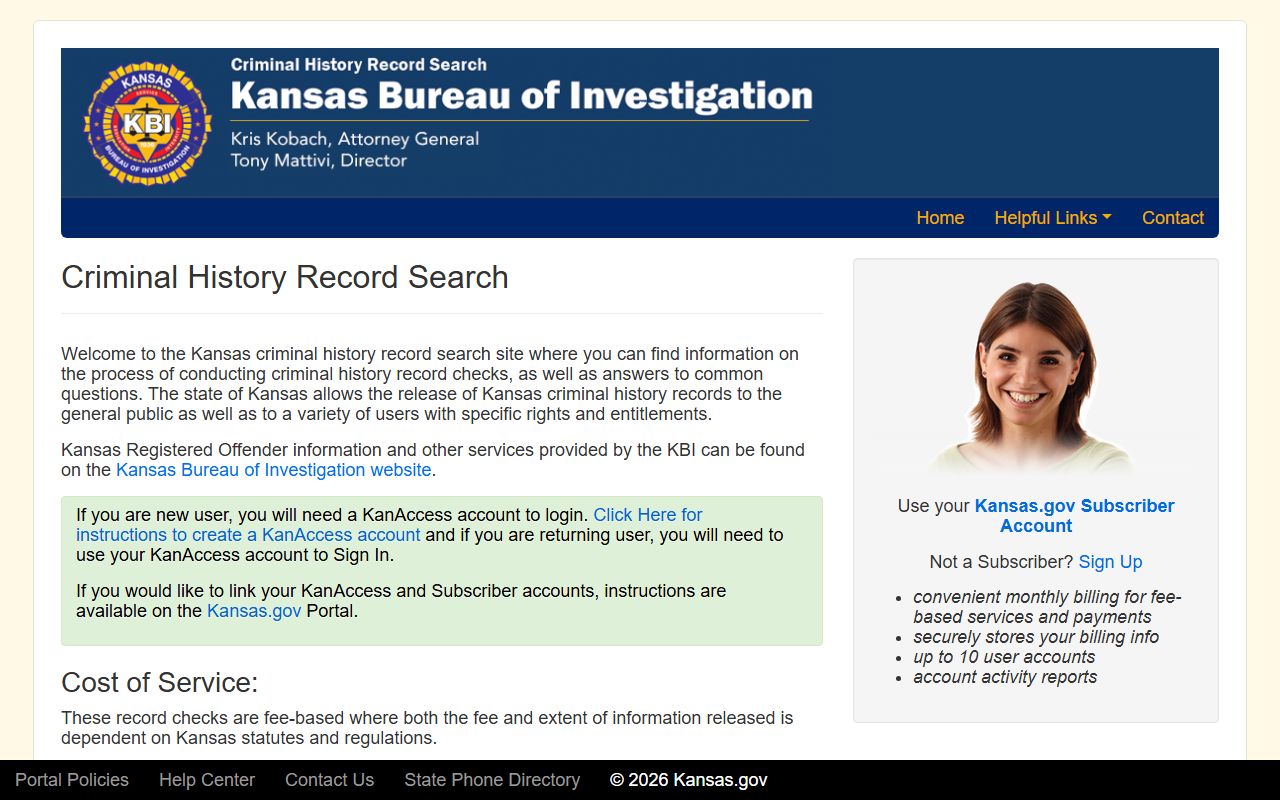
For court charges after arrest, KBI history can be useful background, but the filed charge and disposition should be verified in the court case.
The Kansas Bureau of Investigation homepage is another official state source tied to criminal history and offender resources.
That state-level source should not be confused with a local Harper County booking roster, which official county research did not locate.
Diversion and Amended Charges
The Harper County Attorney page states that DUI and criminal diversion programs are available through the office and that people should contact the County Attorney for qualification, costs, criteria, obligations, effects of the diversion agreement, and other terms. Diversion can affect how charge records are read because a person may be charged, enter a diversion agreement, and avoid a conviction if all terms are completed. If diversion fails, the case may return to ordinary prosecution.
Amendments are also common in charge records. A count may be changed after evidence review, plea discussions, or legal rulings. A court charge record should therefore be read in sequence: original charge, amended charge, current status, disposition, and sentence or diversion result. The first charge listed is not always the final legal outcome.
Warrants Bond and Court Charges
An arrest may begin with a warrant, and a court case may later include bond orders, bench-warrant events, failure-to-appear entries, or warrant returns if public. Harper County research did not locate an official active warrant list. Warrant questions can involve the Sheriff's Office, District Court, or the municipal court that issued the city case. Bond details may appear in a court record after filing, but active law-enforcement warrant status should be confirmed through official channels.
Ignored court charges can create new problems. Missing a District Court date, failing to comply with an order, or missing a municipal court setting can lead to bench-warrant or license consequences depending on case type. For immediate warrant risk, use the correct court and sheriff contacts rather than relying on unofficial search sites.
Sealed vs Expunged Charge Records
Some arrest records and court charges after arrest are not public. Juvenile offender matters, sealed cases, expunged records, investigation records, and sensitive personal identifiers may be withheld or redacted. Kansas expungement law includes K.S.A. 21-6614 for certain convictions, arrest records, and diversion agreements. Juvenile expungement is addressed in K.S.A. 38-2312.
| Sealed | Expunged | |
|---|---|---|
| Public access | Closed or limited by law, rule, or court order. | Public access is limited after a granted expungement order. |
| Typical path | May occur by statute or judge's order. | Usually requires a petition in the court where the matter occurred. |
| Effect | The public may not see the record or may see only limited data. | Specific agencies may still have access for purposes allowed by law. |
| Harper County start point | Contact the court that holds the sealed case. | Start with Harper County District Court or the municipal court that handled the matter. |
Restricted Harper County Arrest Records
Kansas public access rules do not make every arrest or charge detail public. Criminal investigation records can be exempt under the Kansas Open Records Act. Juvenile records, medical details, Social Security numbers, financial account numbers, minor information, sealed warrants, and expunged records can be withheld. A public CaseSearch result may show a case exists while keeping documents or sensitive fields out of view.
For Harper County, the best official chain is clear. Custody and booking questions go to the sheriff. Filed District Court charges go to CaseSearch, the courthouse terminal, or the Clerk of the District Court. Municipal charges go to the city court. Statewide criminal history goes to KBI. Each channel answers a different question, and mixing them can lead to a wrong conclusion about charge status or outcome.